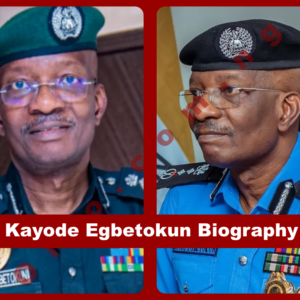
Kayode Egbetokun was Nigeria’s 22nd Inspector General of Police, born September 4, 1964. Mathematics graduate who served from 2023-2026. Read his full biography.
Kayode Egbetokun is a distinguished Nigerian police officer who served as the 22nd Inspector General of Police from June 19, 2023, until his resignation on February 24, 2026. Born on September 4, 1964, in Erinja, Yewa South Local Government Area of Ogun State, he brought over three decades of policing experience to the nation’s highest law enforcement position. His tenure was marked by efforts to modernize the Nigeria Police Force through technology integration and policy reforms.
Before his appointment as IGP, Egbetokun held various strategic positions within the force, including serving as Chief Security Officer to President Bola Tinubu during his governorship of Lagos State from 1999 to 2007. His unique background as both a mathematician and law enforcement professional distinguished him among his peers. At 61 years old at the time of his resignation, he left behind a complex legacy shaped by both achievements and controversies during his leadership of Africa’s largest police force.
Quick Facts About Kayode Egbetokun
| Detail | Information |
|---|---|
| Full Name | Kayode Egbetokun Olukayode Adeolu |
| Date of Birth | September 4, 1964 |
| Age | 61 years (as of 2026) |
| Birthplace | Erinja, Yewa South LGA, Ogun State |
| Profession | Police Officer (Retired) |
| Rank | Inspector General of Police (Former) |
| Net Worth | ₹250 Million (approx.) |
| Spouse | Elizabeth Egbetokun |
| Children | Multiple (including son Victor) |
| Education | B.Sc. Mathematics, M.Sc. Engineering Analysis, MBA, PhD |
| Years of Service | 35 years (1990-2025) |
| Famous For | 22nd IGP of Nigeria, CSO to Tinubu |
Early Life and Background
Kayode Egbetokun was born into a Yoruba family in the rural town of Erinja in Ogun State’s Yewa South Local Government Area. His upbringing in this southwestern Nigerian community instilled in him values of discipline, hard work, and public service that would later define his career trajectory. While specific details about his parents remain private, he was raised in a household that emphasized education and moral integrity.
Growing up in Ogun State during the 1970s and early 1980s, Egbetokun witnessed Nigeria’s transition through various political dispensations. These formative years shaped his understanding of security challenges and governance. His early interest in mathematics and analytical thinking set him apart from his peers. The discipline required for mathematical excellence would later prove invaluable in his strategic approach to law enforcement.
His ethnicity is Yoruba, and he practices Islam. These cultural and religious foundations influenced his leadership style and approach to community policing. From a young age, he demonstrated the intellectual curiosity and determination that would carry him through a distinguished career spanning over three decades.
Academic Excellence and Educational Journey
Egbetokun’s academic journey began with his admission to the University of Lagos, Akoka, where he pursued a Bachelor of Science degree in Mathematics. He graduated with honors in June 1987, demonstrating exceptional analytical abilities. His strong performance in mathematics reflected his methodical thinking and problem-solving skills. These qualities would later become assets in criminal investigation and strategic police operations.
Following his undergraduate degree, he briefly served as a Mathematics lecturer at Yaba College of Technology in Lagos. This teaching experience enhanced his communication skills and ability to break down complex concepts. However, his calling to public service led him to pursue a career in law enforcement rather than academia.
Egbetokun continued his education even while serving in the police force, earning a Master of Science degree in Engineering Analysis from the University of Lagos in 1996. He further obtained a Postgraduate Diploma in Petroleum Economics from Delta State University, Abraka, in 2000. In 2004, he completed a Master of Business Administration from Lagos State University, Ojo. His pursuit of knowledge culminated in a PhD in Peace and Security Studies from Al-Hikmah University in Ilorin, Kwara State. This extensive educational background made him one of the most academically qualified police officers in Nigeria.

Entry into the Nigeria Police Force
On March 3, 1990, Kayode Egbetokun enlisted in the Nigeria Police Force as a Cadet Assistant Superintendent of Police under Course 16. This marked the beginning of a 35-year career that would take him to the pinnacle of law enforcement in Nigeria. His entry coincided with a period of significant change in Nigerian policing, as the force sought to professionalize its operations.
As a young officer, Egbetokun distinguished himself through dedication and competence. His mathematical background gave him an edge in criminal analysis and investigative work. He quickly earned respect from colleagues and superiors for his analytical approach to solving cases. His early postings exposed him to various aspects of policing, from community relations to criminal investigations.
The combination of his academic credentials and practical policing skills set him on an accelerated career path. He attended numerous professional development courses, including the Close Protection Course in the United Kingdom and the Squadron Commander Combat Operations Course. His participation in the Advanced Detective Course at the Police Staff College in Jos further honed his investigative expertise. These training programs equipped him with international best practices in law enforcement.
Chief Security Officer to Governor Tinubu
In 1999, as a Deputy Superintendent of Police, Egbetokun received a career-defining appointment as Chief Security Officer to the newly elected Governor of Lagos State, Bola Ahmed Tinubu. This position placed him at the center of security planning for Nigeria’s commercial capital. He coordinated security operations across the entire state, reporting directly to the governor. His tenure in this role lasted until 2005, spanning Tinubu’s first term and part of his second.
During this period, Lagos faced numerous security challenges, including armed robbery, cultism, and political violence. Egbetokun developed comprehensive security strategies that balanced law enforcement with community engagement. His close working relationship with Tinubu during this period would prove significant decades later when Tinubu became President. The trust established during these years in Lagos laid the groundwork for his eventual appointment as Inspector General of Police.
His performance as CSO earned him recognition as an effective security administrator. He demonstrated the ability to manage complex security situations while maintaining professional integrity. The experience provided him with insights into the intersection of politics and security that would inform his later leadership.

Rise Through Police Ranks
After his tenure as CSO, Egbetokun continued his ascent through the police hierarchy. From 2005 to 2007, he commanded the Rapid Response Squad (RRS) in Lagos State. The RRS was a specialized unit known for its quick response to crimes and emergencies. Under his leadership, the squad enhanced its operational effectiveness and public perception. He introduced tactical innovations that improved response times and arrest rates.
He subsequently served in various command positions, including Squadron Commander of the Mobile Police (MOPOL) and Officer in Charge of the Anti-Fraud Unit at the FCT Command in Abuja. These roles exposed him to different dimensions of law enforcement, from riot control to financial crimes investigation. He also served as Chief Superintendent of Police for Administration at Lagos State Command Headquarters in Ikeja.
His leadership abilities were further tested as Area Commander in Osogbo, Osun State, and Gusau, Zamfara State. These postings in different geopolitical zones provided him with a national perspective on security challenges. He gained valuable experience managing security in areas affected by insurgency, banditry, and communal conflicts. His success in these challenging environments marked him as a capable administrator deserving of higher responsibilities.
Commissioner of Police Assignments
Egbetokun’s promotion to Commissioner of Police on September 29, 2020, marked his entry into senior police leadership. He was initially deployed to Kwara State Command, where he oversaw policing operations across the state. His tenure in Kwara demonstrated his capacity to manage large-scale security operations and coordinate multiple police divisions. He focused on improving community relations and operational efficiency.
He subsequently served as Commissioner of Police for several specialized departments at the Force Headquarters in Abuja. These included Servicom (Service Compact with Nigerians), which focused on improving police-public relations. He also headed the Explosive Ordnance Disposal (EOD) unit, dealing with bomb threats and related security challenges. His technical background proved valuable in managing this critical department.
Additional assignments included Commissioner for Admin Medical Falomo in Lagos State. These varied roles at both command and headquarters levels provided him with comprehensive understanding of police operations. His performance consistently earned positive evaluations from superiors. He became known for his systematic approach to problem-solving and his commitment to institutional improvement.
Path to Deputy Inspector General
In September 2022, Egbetokun attained the rank of Assistant Inspector General of Police and was deployed to Zone 7 Headquarters in Abuja. This zonal command covered multiple states in the North Central region. His responsibilities included coordinating operations across state commands and providing strategic oversight. He addressed security challenges including banditry, kidnapping, and communal violence that plagued the zone.
On March 29, 2023, he received promotion to Deputy Inspector General of Police and was assigned to head the Force Criminal Investigation Department (FCID) at Force Headquarters. This appointment placed him in charge of Nigeria’s premier investigative unit. The FCID handles high-profile cases, organized crime, and complex investigations requiring specialized expertise. His leadership of this critical department demonstrated the confidence that police leadership had in his abilities.
As DIG, he supervised the South-West geopolitical zone, overseeing police operations in Lagos, Ogun, Oyo, Osun, Ondo, and Ekiti states. This region includes Nigeria’s economic hub and faces unique security challenges. His familiarity with Lagos from his earlier postings proved advantageous. During this period, he implemented reforms to improve investigative procedures and case management systems.
Appointment as Inspector General of Police
On June 19, 2023, President Bola Ahmed Tinubu appointed Kayode Egbetokun as the 22nd Inspector General of Police, replacing Usman Alkali Baba. The appointment came shortly after Tinubu assumed office as President. While Egbetokun’s long-standing professional relationship with Tinubu was well-known, the President emphasized that the appointment was based on merit and experience. The Nigeria Police Council confirmed his substantive appointment on October 31, 2023.
At 58 years old at the time of appointment, Egbetokun was scheduled to retire at age 60 in September 2024 according to standard police regulations. However, the National Assembly amended the Police Act in 2024, allowing an appointed IGP to serve a fixed four-year term regardless of age or years of service. This amendment allowed Egbetokun to continue beyond his retirement age. In 2025, President Tinubu granted him a one-year extension to his tenure.
His appointment was met with mixed reactions. Supporters pointed to his extensive experience, academic qualifications, and proven leadership in various capacities. Critics raised concerns about his close ties to the President and questioned whether he could maintain the independence required of the nation’s chief law enforcement officer. Despite the controversy, he assumed office with ambitious plans for police reform.
Leadership Philosophy and Reform Initiatives
Upon assuming office as IGP, Egbetokun articulated a vision centered on modernizing the Nigeria Police Force. He prioritized integrating advanced technology into policing operations, aiming to shift from reactive approaches to predictive, data-informed strategies. He emphasized the need for intelligence-led policing rather than relying solely on traditional methods. His mathematical and analytical background influenced this technological focus.

He implemented policies aimed at improving officer welfare, recognizing that poor working conditions contributed to inefficiency and corruption. He advocated for better remuneration, housing, and health benefits for police personnel. His personal ethos centered on discipline, integrity, and dedication to public service. He consistently emphasized these principles in addresses to officers and the public.
Egbetokun promoted community policing initiatives, seeking to rebuild trust between police and citizens. He recognized that effective law enforcement requires public cooperation. He also focused on training and capacity building, sending officers for specialized courses both domestically and internationally. His reforms touched various aspects of police operations, from criminal investigation procedures to traffic management systems.
Controversies and Challenges During Tenure
Egbetokun’s tenure as IGP was marked by significant controversies that affected public perception of his leadership. During the #EndBadGovernance protests from August 1 to 10, 2024, Amnesty International alleged that Nigerian police employed excessive force against demonstrators. The organization reported at least 24 deaths, including minors, resulting from the use of live ammunition and tear gas on peaceful gatherings. Specific incidents included the shooting of 16-year-old Habib Lawan in Borno State on August 2.
These allegations sparked intense criticism of police tactics under Egbetokun’s leadership. Human rights organizations accused him of failing to uphold international standards on protest policing. The IGP defended police actions, claiming officers responded to violent elements infiltrating peaceful protests. However, critics argued that the response was disproportionate and violated citizens’ constitutional rights to peaceful assembly. The controversy damaged the police’s reputation and intensified calls for accountability.
Security challenges persisted throughout his tenure, with rising incidents of kidnapping, banditry, and terrorism in various parts of the country. Critics pointed to insufficient police presence in rural areas and inadequate response to emerging threats. Analysts cited chronic underfunding, insufficient manpower relative to Nigeria’s population, and poor service conditions as limiting factors. However, supporters argued that these institutional deficits predated Egbetokun’s appointment and required long-term systemic solutions beyond any single IGP’s capacity.
Family Life and Personal Interests
Kayode Egbetokun is married to Elizabeth Egbetokun, who has actively supported police welfare initiatives. She commissioned the POWA Model Children School in Bauchi State on May 15, 2025, demonstrating her commitment to police families. The couple has children, including their son Victor Egbetokun, whose wedding to Anjolaoluwa Olaoluwakitan took place on August 22, 2024, in Lagos. The ceremony was attended by prominent figures including Vice President Kashim Shettima, reflecting the family’s connections within Nigeria’s political establishment.

Despite the public nature of such family events, Egbetokun maintained a relatively low profile for his personal life. He focused attention on institutional roles rather than seeking personal publicity. His approach reflected his professional demeanor and preference for letting his work speak for itself. He rarely granted personal interviews or appeared in social settings unrelated to official duties.
In his leisure time, Egbetokun enjoys reading, particularly books on leadership, security studies, and history. He is an avid supporter of Chelsea Football Club in the English Premier League and follows the team’s performances closely. He also plays table tennis and enjoys recreational football when time permits. These hobbies provide him with necessary relaxation from the demanding responsibilities of high-level law enforcement leadership.
Net Worth and Financial Standing
As a senior public official, Kayode Egbetokun’s financial status has been subject to public scrutiny. While he has not publicly disclosed his exact net worth, estimates place it at approximately ₹250 million (about $300,000 USD). This figure reflects earnings accumulated over his 35-year career in the Nigeria Police Force. As IGP, his monthly salary and allowances were among the highest in the force, though still modest compared to private sector executives.
His wealth likely includes pension benefits, property investments, and savings accumulated through legitimate earnings. As a high-ranking officer, he had access to official residences and vehicles, reducing personal expenses. However, there is an expectation of financial transparency for public officials of his rank. No credible allegations of corruption or unexplained wealth have emerged publicly against him.
The Nigeria Police Force has faced persistent challenges regarding officer welfare and compensation. Throughout his tenure, Egbetokun advocated for improved salaries and benefits for all ranks. His personal financial situation, while comfortable by Nigerian standards, reflected the limitations of public service compensation. His net worth is significantly lower than many private sector professionals with comparable education and experience.
Resignation and Departure from Office
On February 24, 2026, Kayode Egbetokun resigned as Inspector General of Police, ending his tenure after approximately two years and eight months in office. Presidential spokesperson Bayo Onanuga confirmed the resignation, stating that Egbetokun cited “personal family reasons” in his resignation letter submitted that Tuesday. The Presidency clarified that he resigned voluntarily and was not dismissed or forced out, though some reports suggested he was asked to step down during a meeting with President Tinubu at the Presidential Villa on Monday, February 23.
At 61 years old and having completed 35 years of service, Egbetokun had reached a natural transition point in his career. His resignation came amid ongoing criticism of Nigeria’s worsening security situation, including surges in kidnapping, banditry, and terrorist attacks. While the Presidency emphasized family reasons, political observers noted the timing coincided with mounting pressure over security challenges. The official statement promised further details would be released later.

His resignation marked the end of a distinguished but controversial career at the helm of Africa’s largest police force. He was expected to be replaced by Assistant Inspector General Tunji Disu, according to sources within the presidency and police headquarters. Preparations for a formal handover ceremony were reportedly underway at the time of his resignation. His departure closed a chapter that began with his appointment amid high expectations for reform and modernization.
Legacy and Impact on Nigerian Policing
Kayode Egbetokun’s legacy as Nigeria’s 22nd Inspector General of Police remains complex and subject to ongoing evaluation. On one hand, he brought unprecedented academic credentials to the position, combined with diverse operational experience across multiple police commands and specialized units. His efforts to integrate technology into policing operations represented a forward-thinking approach to modern law enforcement challenges. He consistently emphasized the importance of training, professionalism, and integrity within the force.
However, his tenure was overshadowed by persistent security challenges and controversial incidents, particularly the handling of the 2024 #EndBadGovernance protests. The allegations of excessive force and human rights violations raised serious questions about police accountability under his leadership. His critics argue that he failed to achieve significant improvements in public safety or police-community relations during his time as IGP. The security situation in many parts of Nigeria arguably worsened during his tenure.
Supporters contend that many challenges he faced were structural and beyond any individual leader’s control. Chronic underfunding, insufficient personnel, inadequate equipment, and systemic corruption are deeply entrenched problems requiring sustained political will and resources to address. Egbetokun’s advocates point to his efforts at policy reform and his advocacy for improved officer welfare as positive contributions. His impact on Nigerian policing will be fully assessed only with the perspective of time and subsequent developments in the force.
Final Thoughts
Kayode Egbetokun’s journey from a mathematics graduate to the Inspector General of Police represents a remarkable career trajectory in Nigerian public service. His 35 years in law enforcement spanned the transition from military to civilian rule and witnessed the evolution of security challenges facing Africa’s most populous nation. His unique combination of academic excellence and operational experience made him a distinctive figure in Nigerian law enforcement leadership.
His appointment as IGP in 2023 came with high expectations, given his educational credentials and diverse experience across various police commands. However, the reality of Nigeria’s complex security environment proved more challenging than anticipated. The controversies that marked his tenure, particularly regarding protest policing and persistent insecurity, complicated his legacy. His resignation in February 2026 citing family reasons brought his term to an end earlier than expected.

As he departs office at 61, Egbetokun leaves behind a mixed record that future scholars and practitioners of law enforcement will continue to examine. His story offers valuable lessons about the challenges of police leadership in developing democracies, the importance of institutional capacity, and the complex relationship between political connections and professional merit. His contributions to discussions about police modernization and officer welfare may prove to be his most enduring legacy, even as debates continue about his overall effectiveness as Nigeria’s chief law enforcement officer.
Frequently Asked Questions
Q1: Who is Kayode Egbetokun?
Kayode Egbetokun is a former Nigerian police officer who served as the 22nd Inspector General of Police from June 19, 2023, to February 24, 2026. Born on September 4, 1964, in Ogun State, he had a 35-year career in law enforcement. He previously served as Chief Security Officer to President Bola Tinubu during Tinubu’s tenure as Lagos State Governor.
Q2: What is Kayode Egbetokun’s educational background?
Egbetokun holds a Bachelor of Science degree in Mathematics from the University of Lagos (1987) and briefly lectured at Yaba College of Technology. He earned a Master of Science in Engineering Analysis from the University of Lagos (1996), a Postgraduate Diploma in Petroleum Economics from Delta State University (2000), an MBA from Lagos State University (2004), and a PhD in Peace and Security Studies from Al-Hikmah University, Ilorin.
Q3: Why did Kayode Egbetokun resign as IGP?

Egbetokun officially resigned on February 24, 2026, citing personal family reasons in his resignation letter. However, some sources reported he was asked to step down during a meeting with President Tinubu amid criticism over Nigeria’s worsening security situation. The Presidency clarified that he resigned voluntarily and was not dismissed from office.
Q4: What is Kayode Egbetokun’s net worth?
While Egbetokun has not publicly disclosed his exact net worth, estimates place it at approximately ₹250 million (about $300,000 USD). This reflects earnings accumulated over his 35-year career in the Nigeria Police Force. As a high-ranking public official, there is an expectation of financial transparency, and no credible allegations of corruption or unexplained wealth have emerged publicly.
Q5: What were the major controversies during Egbetokun’s tenure as IGP?
The most significant controversy involved allegations of excessive force by police during the August 2024 #EndBadGovernance protests. Amnesty International reported at least 24 deaths, including minors, from the use of live ammunition and tear gas. His tenure also faced criticism over Nigeria’s worsening security situation, including increases in kidnapping, banditry, and terrorism. Critics questioned his effectiveness in addressing these challenges.
Q6: What was Egbetokun’s relationship with President Bola Tinubu?
Egbetokun served as Chief Security Officer to Bola Tinubu when Tinubu was Governor of Lagos State from 1999 to 2007. This professional relationship established during those years led to questions about independence when Tinubu, as President, appointed him IGP in June 2023. While their long-standing relationship was well-known, both maintained that the appointment was based on merit and experience.
Q7: Who is Kayode Egbetokun’s wife and family?
Kayode Egbetokun is married to Elizabeth Egbetokun, who has been active in police welfare initiatives. The couple has multiple children, including their son Victor Egbetokun, who married Anjolaoluwa Olaoluwakitan in August 2024 in a ceremony attended by Vice President Kashim Shettima. Egbetokun maintained a relatively private family life despite his high-profile position.